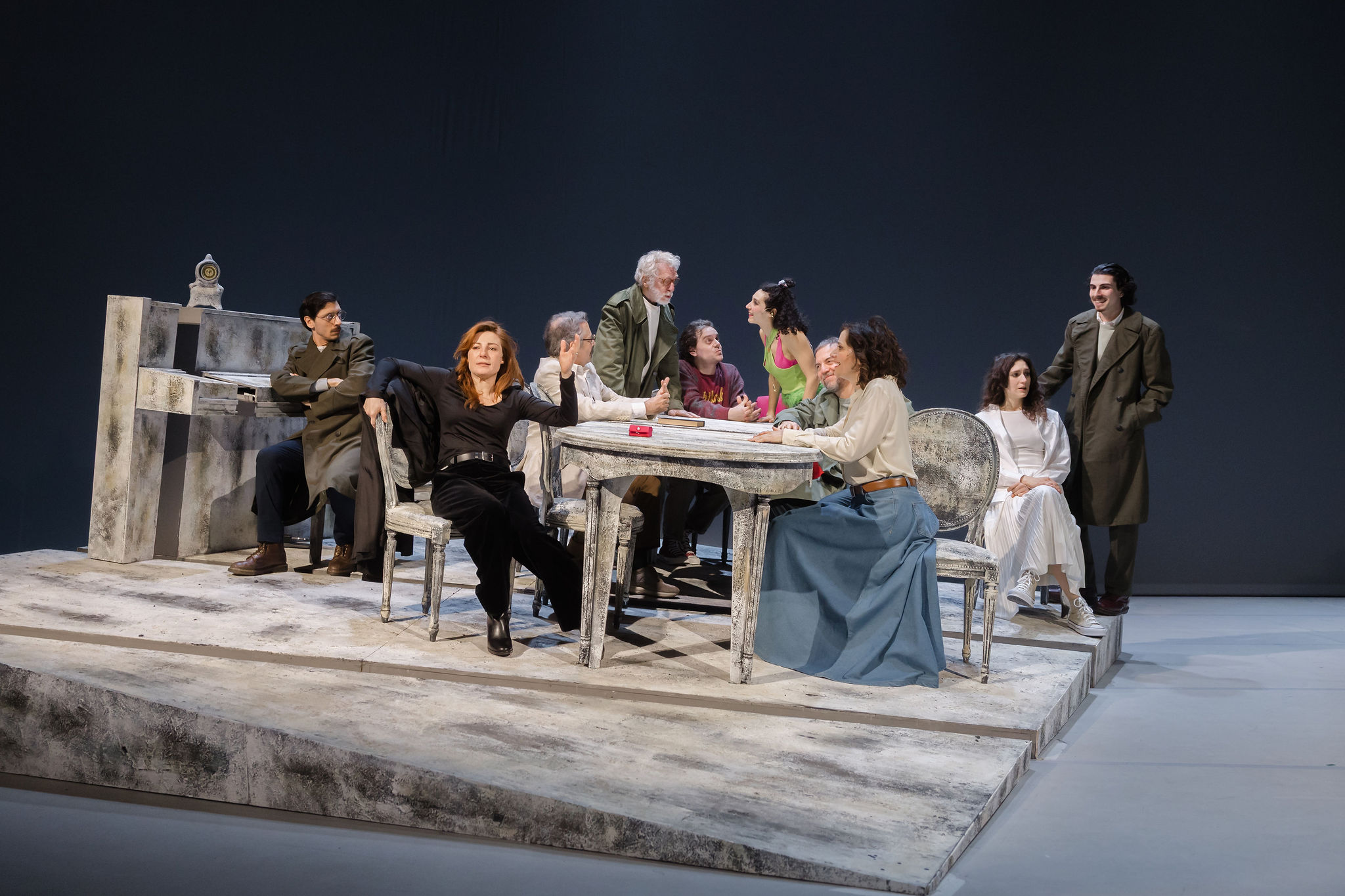
Three sisters. It snows. What’s the point? It’s Liv Ferracchiati’s latest work, playing at Rome’s Teatro India from April 28 to May 3: a third rewriting of a Chekhovian text after Platonov and How Things Tremble Reflected in Water, the director presents the public with the latest reimagining of one of the twentieth century’s most famous plays, a perennial fixture in theatre bills and seasons. Striking is the delicate interplay between the original Chekhovian writing—one of the most daring texts to rework—and Ferracchiati’s words. Striking is the delicate interplay between the original Chekhovian writing—one of the most daring texts to rework—and Ferracchiati’s words. The voice is the same, the tone is new: the parlor radio plays a recording of Rosalia’s Bizcochito , while Masha—the youngest sister—hums a verse. Taking inspiration from the original play, “Meanwhile, I’d like ta-ra-ra bum diè to always be here with you, ta-ra-ra bum diè”: the heart that remains is the same.
Thus, the rewriting becomes contamination, grafting, the fertilization of the classic with the contemporary, a continuous act of love that does not betray but expands the horizons of meaning. As the actresses and actors tell us during the talk with the Young Board, part of the work we see on stage is the result of guided improvisations, born from the relational premises between the characters, who simply underline and enhance characteristics already present in the text. Another predominant element in the production is repetition, the cyclicality with which scenes, characters, and dynamics return and present themselves again before the audience, outlining directorial choices that are not afraid to move away from the naturalism usually associated with Chekhov, but rather make symbolism a weapon against the everyday life from which one cannot escape. “I want, I want, I want!”, “I’m thirsty, I want you (tea?)”, every time we hear them, the same words take on a different meaning, touching different worlds and chords, masking profound pain through repetition.
Meanwhile, the clock keeps ticking: the last remaining memory of their mother, her time. When that breaks, everything stops with her, like a great mourning. So it makes no sense for it to snow on May 5th, so the characters’ words blend into one another, in a wave that starts with them and reaches the audience, bringing us all their lives. Their interactions, however, are much more disjointed: they never understand each other, and it takes our gaze to make them feel understood.
Like snow that does not want to leave the mountains, here we are: tightly, tightly clinging to the dreams we love. Perhaps it snows outside for this reason. Look at all the flakes: how many are the things we want, and how little do they last.
At the end, the three sisters, left alone, put on a grey coat: an intense birch color, scraped away by time. Their home.
Anna Cipriani and Chiara Puchetti