
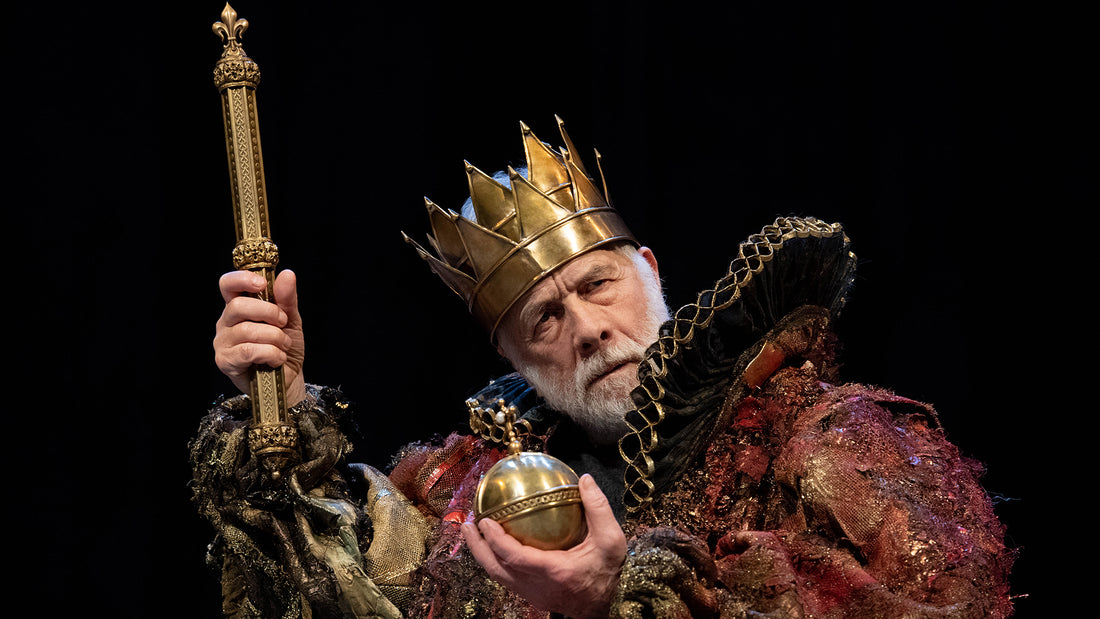
King Lear - a man in the storm of life

King Lear - a man in the storm of life
Gabriele Lavia returns to the Teatro Argentina with a production particularly dear to him, a tribute to the master Giorgio Strehler, who directed him at the time in the role of young Edgar. Fifty years later, with a wealth of experience and greater awareness, Lavia brings back to the stage the Shakespearean drama that, more than any other after Hamlet, explores the great existential dilemma of human life: what remains when we stop "being"?
This time, however, he chooses to step into the role of the elderly King Lear, a “poor” man who finds the strength to rediscover himself amidst solitude and regret, staging the infinite drama of the human being who, amid betrayals, losses, and lies, tries to make his way through the impetuous storm of life.
Now too old to rule a kingdom as vast as that of Britain, King Lear decides to abdicate and divide the land among his three daughters. While Goneril and Regan, the two eldest daughters—married respectively to the Duke of Cornwall and the Duke of Northumberland—react enthusiastically to the news and are willing to profess their love for their father in words, Cordelia, the third and youngest daughter, rejects numerous suitors in the name of a more sincere love for her father. The young Cordelia’s intellectual and emotional honesty, as well as her profound sincerity, are not, however, appreciated by her elderly father, who, displeased, decides to disown her and divide his inheritance between the two sisters.
What seems to be a wise decision, however, leaves room for the plot long devised by Goneril and Regan; the two women are not guided by loving feelings toward their father, nor did they accept his inheritance to relieve him of the heavy burden of power, but rather to further their own selfish ambitions. Like true leeches, slowly and almost imperceptibly, they strip their father of everything, even his hundred knights, until they completely abandon him in the midst of an impetuous storm.

Stripped of all wealth, possessions, and titles, Lear discovers in his wandering the harsh truth of “non-being,” realizing that all his existence had been contained in that small word: “King.” In fact, the moment he renounced his role, he accepted to become a “man who is nothing.” And it is precisely this “nothingness” that becomes the vortex that overwhelms him; on stage, wind, thunder, and lightning simulate the natural storm, while the inner storm makes its way into Lear’s mind and shatters every certainty, leaving no possibility of remedy.
While Lear continues his journey in search of that lost self, accompanied by the only two people who remain by his side—the Fool and a beggar, who is actually his loyal advisor Kent—the two sisters continue their power plots, to which is added that of Edmund, the son of the Earl of Gloucester, who wants to rid himself of the label of “bastard” once and for all, directing his revenge against both his father and his long-favored brother Edgar.
Relying on his “cursed charm,” Edmund wins the favor of Goneril and Regan, pitting them against each other and, through a series of deceptions, managing to make their father appear treacherous in the eyes of the entire court after professing his loyalty to Lear, and having his brother banished.
Thus, just as Lear wanders the streets trying to accept his own “non-being,” Edgar voluntarily gives up his own self to temporarily become the poor madman Tom, whom Lear takes with him. Two sides of the same coin recognize themselves in one another and help each other: Lear realizes that only in his state of non-being is he able to truly “see” things as they are, thus managing to reunite with Cordelia, the lost daughter, the only one he should have trusted; conversely, it is precisely through the deprivation of his own self that Edgar is able to find his freedom as a man and his own redemption, succeeding in avenging his father’s death and putting an end to his brother’s deceptions.
And in the end, in this world of fools, among those who die blinded by power and those who are reborn inwardly in a new form of being, as the lights fade, appears the shadow of the only character who has always understood the true essence of man and life: it is the Fool who, to the sound of his sweet accordion, leaves us with the bitterest reflection on humanity.
by Vittoria Federiconi and Vittoria Ferraro Petrillo