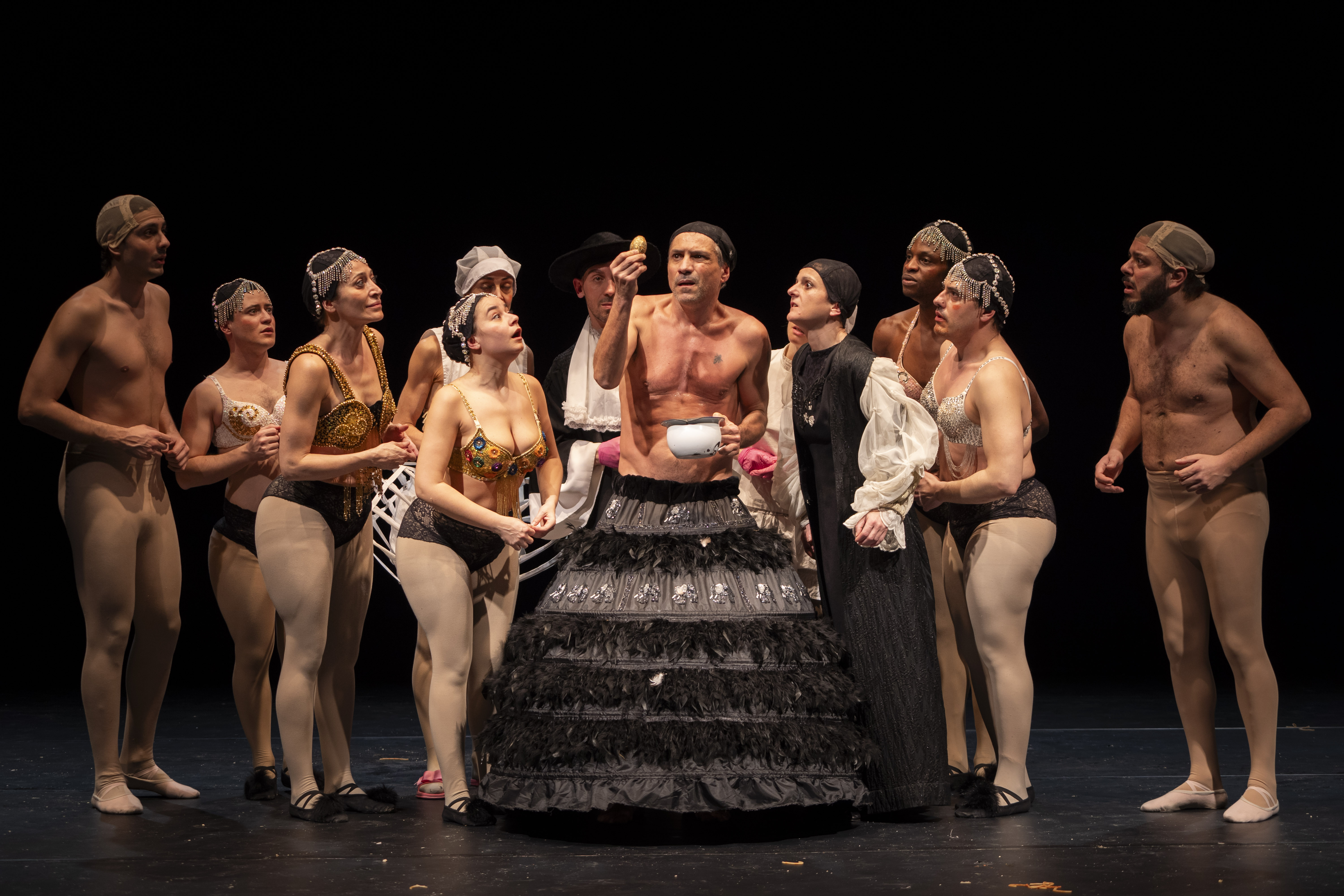
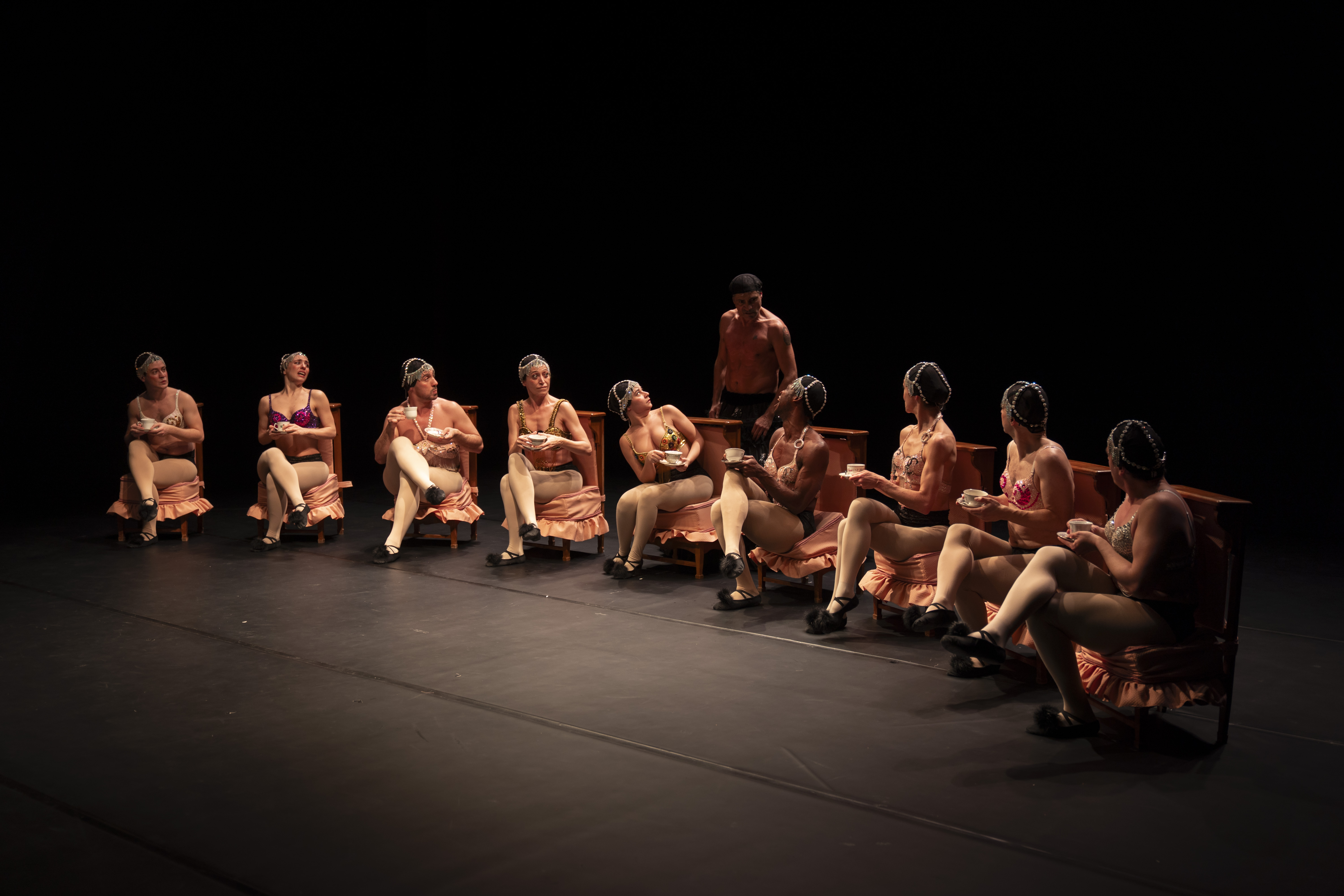
The squawking of the court ladies who come to wish the sire good morning provokes a spontaneous laugh, if only because of their parrot-like repetition of phrases and gestures in an attempt to display an elegance that is actually unseemly; yet it takes little to see that their interest is not in the king, but in his riches, which they enjoy like leeches.
His wife (Annamaria Palomba) probably always detested him, never able to tolerate his lack of refinement, his inability to appreciate true beauty, his rejection of etiquette—all unacceptable to her, a daughter of a strict French upbringing.
Even his daughter (Angelica Bifano), perhaps the only one with even a modicum of genuine concern for her father's condition, is sucked into the splendor, stripped of her white dress as well as her innocence, dragged by the court ladies into a luxury as unbridled as it is superficial, turning a simple tea time into a gaudy display.
Thus, a court full of people who see their king as an opportunity, an estate, a collection of titles and riches, but certainly not as a person; no one is able to understand his pain or his desperate need for help—after all, they cannot even tell the man apart from the hen, because deep down, the animal is merely another source of profit for them.
For if his presence did not allow the king to lay golden eggs every time he ate or drank anything, none of them would care so much about his health, nor bother to feed and water him; and this harsh truth becomes even clearer when the only possible solution in the king's eyes is a difficult choice: life or the hen, solitude or death.
At this point, one might ask who the real villain of this story is: an insolent hen determined to defend herself, or an entire court nourished by false interest and lies; but the truth is that the answer is irrelevant. The only certainty is that “one must die”—this is the fate of everything in the world, and this is the fate of our king, who, for fear of giving in to that hen, lets himself starve to death.
But as we know, life comes and goes; and so, while the memento mori of the Passacaglia della vita echoes through the room, a makeshift funeral pays tribute to King Chicchinella who, having taken on his new form as a hen, enjoys the same old sham adoration from his perch on the throne.
Vittoria Ferraro Petrillo