Walter Álvarez had just packed his books into twenty-six cardboard boxes when a series of fires broke out. Ash, dust, and sulfurous gases blotted out the sun, and it became darker and colder than it had ever been. A global tsunami raised waves never seen before, and an earthquake shook the earth from its core for weeks. It certainly could not be predicted, but Álvarez had not noticed any signs that his wife wanted to leave him. Yet he was a geologist turned aspiring paleontologist and the son of a Nobel Prize-winning physicist—someone from whom one would expect to know how to anticipate events, at least catastrophes. But this time, as 66 million years ago, there was nothing to be done, and the fifth mass extinction occurred, and Walter Álvarez was left by his wife, feeling as alone as the last dinosaur surviving the Asteroid must have felt.
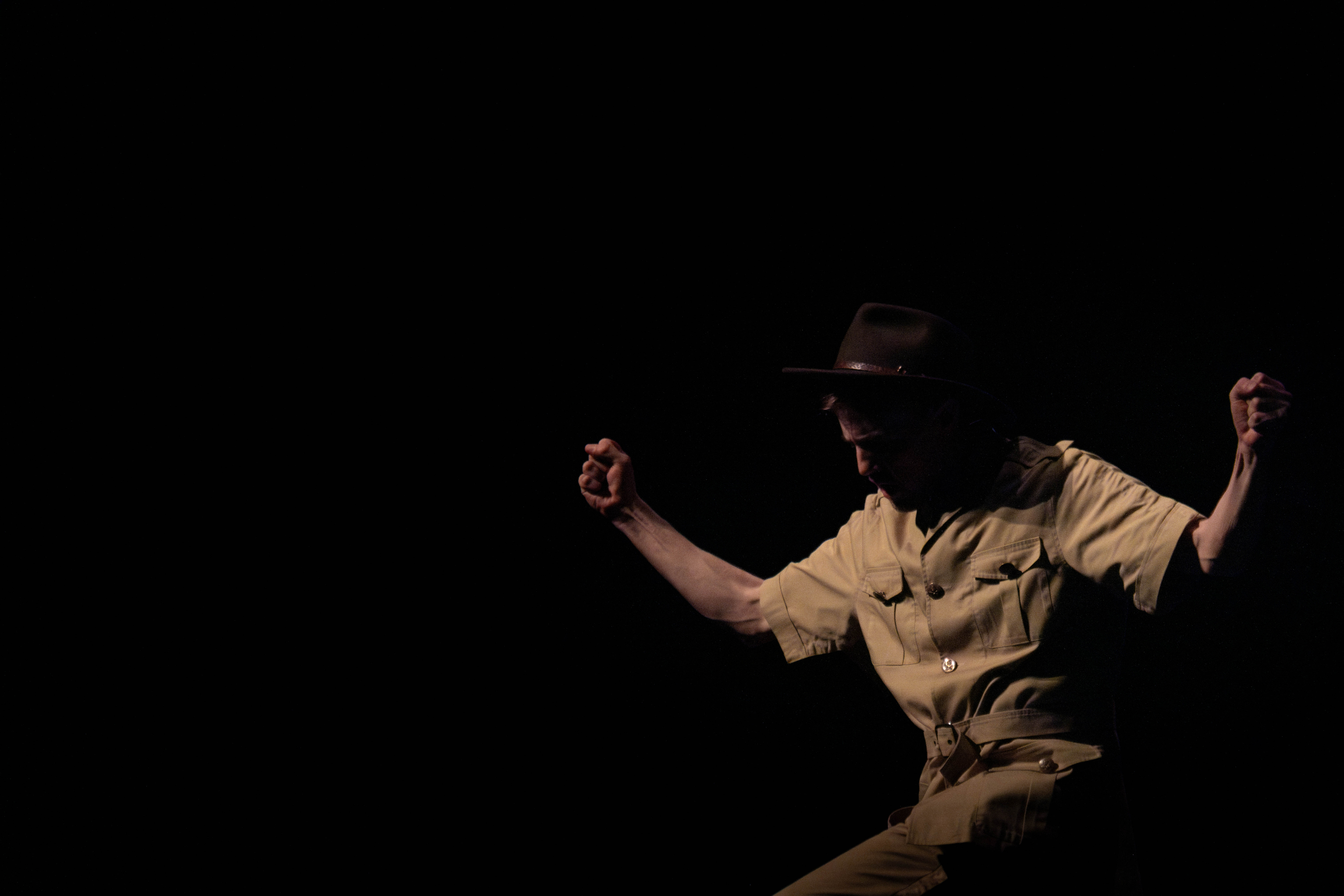
Through the clouds of the impact, a gesture and a song make their way, unexpected meteorites capable of revealing the story of an end. Marco D’Agostin inhabits these distant worlds, and on the half-deserted stage of the Teatro Palladium a solitary musical dance unfolds, while the deep time of geological eras flows by, and the vast spaces of galaxies are revealed. Then, from the body, the first chaotic traces: sudden and unusual, they surface on the skin, and the violent force of a gesture from which there is no escape crashes down on ordinary life; of what came before, only debris and dust remain, and movement, eroded by the serious play of the musical, reveals itself as unknown and familiar, earthly and alien, coral and iridium.
A joyful and solemn song renews the ancient invitation to leave behind the layers of earth and the trails of metals, to bring to bear all the strength, and the irony, necessary for reconstruction. At first, the Asteroid was a distant light, and only a few of us noticed it. Then we accepted that planets are made and unmade, and things were clothed in a different light.
Sofia Carlotto