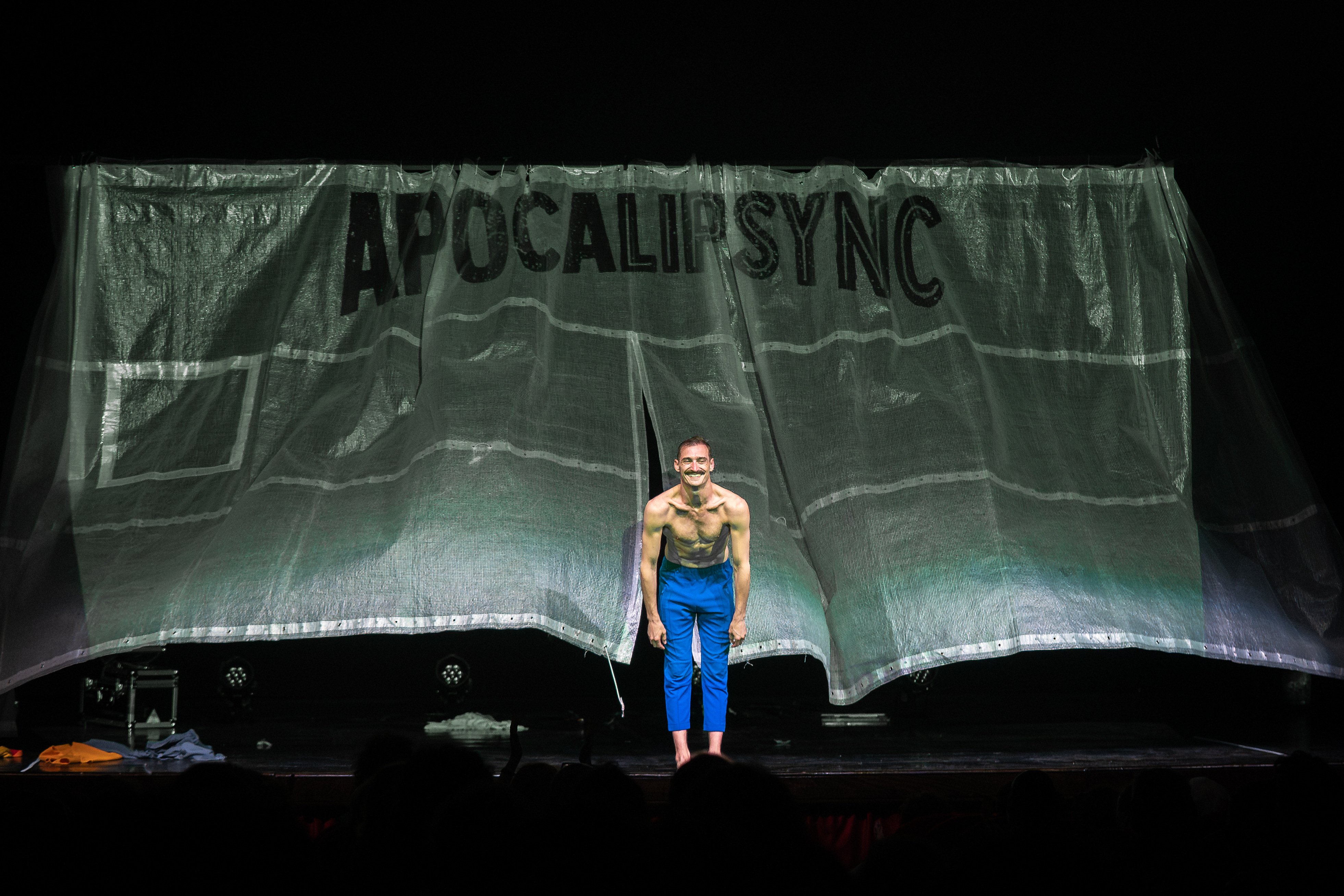
Apocalipsync is the new creation by Luciano Rosso, the multifaceted Argentine dancer, actor, and choreographer who pursues an exploration intertwining physical theatre, movement, and bodily transformation, already at the heart of Un poyo Rojo, a show that has been on international tour for over ten years. Starting from the first lockdown in the spring of 2020, Rosso develops a reflection on the relationship between body, identity, and self-representation in a context dominated by isolation and overexposure to external stimuli. Alone on stage, Luciano Rosso creates a performative device capable of producing a continuous proliferation of presences, images, and memories linked to the recent history of the pandemic, offering the audience a tangible imagery of what happened with Covid-19.
Through lipsync, music, sound, and movement, the show re-examines the loneliness we experienced—particularly that of those working in the entertainment industry—turning it into a vibrant and unexpected creative stimulus. The narrative dimension is not linear, but made up of episodes that come together like variations on the same theme: loneliness as a space for invention. In this context, Rosso's work moves between clowning, physical transformation, and vocal imitation, maintaining a light tone that traverses everyday situations and moments of pure comic distortion. The account of the pandemic period does not focus on reconstructing the events that occurred, but on how that time altered the perception of the body and presence. The relationship with the media—the only means of communicating with the outside world—becomes a metaphor for a new way of relating to an increasingly chaotic, fast-paced, and different world, much like Luciano Rosso's vocal, movement, and costume transformations.
Apocalipsync thus concludes on this constant oscillation between multiplication and subtraction, between play and observation of the present, allowing a body to emerge that continues to change shape while trying to hold together the images that pass through it. An endless story of a changing world, of how we observe it, and of how, ultimately, the world observes us.
Vittoria Ferraro Petrillo