

 Ph. Gianluca Pantaleo
La locandiera
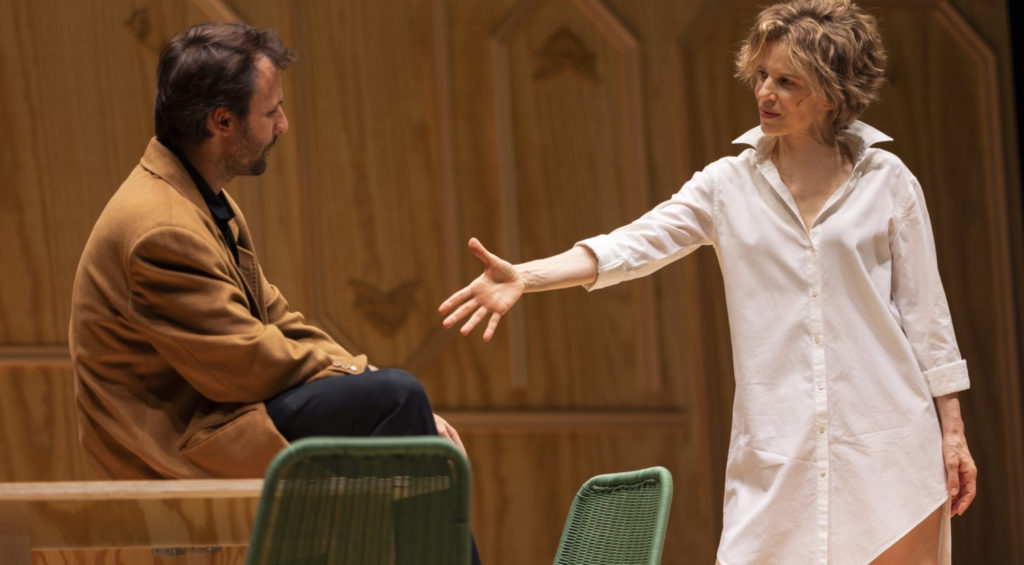
Many pre-Goldonian texts boasted of having treated the female figure (more than anything the relationship between women and men) in an avant-garde and progressive way; few, however, have thought of the female character as a true protagonist. Could this be the case for La Locandiera by Goldoni? The theatrical literature speaks for itself, but to have an even more current and above all physical confirmation, we witnessed Antonio Latella's version performed at the Teatro Argentina from April 17 to 28, 2024.
On stage were the actors Marta Cortellazzo Wiel, Ludovico Fededegni, Giovanni Franzoni, Francesco Manetti, Gabriele Pestilli, Marta Pizzigallo, Valentino Villa and, finally, Sonia Bergamasco, in the role of a modern Mirandolina.
Latella chose to create a minimalist production: a simple and open kitchen, from which smells of minestrone emanate, a table, some linens and a few other objects.. We are right inside an inn, which could be located in any era and therefore capable of creating a certain timelessness. Truly contemporary, on the other hand, are the actors' costumes: the women wear shirts, heels, tight dresses; the men wear tracksuits, baseball caps, while maintaining a language close to the text of the time, in an eclectic mix like themselves.
La Locandiera, in fact, is first and foremost a comedy, known and studied by most Italian students – if not all. Mirandolina, the so-called innkeeper, is a woman known for enchanting everyone, without exception; in particular the Marquis of Forlipopoli and the Count of Albafiorita. The first represents the decadent nobility, and promises to serve her with his power and his protection. While the second, coming from the wealthy bourgeoisie of the time, boasts his riches and his money, buying for her everything that can be bought. Only the Knight of Ripafratta, a highly misogynistic character, seems to resist her; Mirandolina then applies all her art to win him over. Also intent on winning the men and their favor are the other two female figures, Dejanira and Ortensia, "fake ladies" who also try to win the favor of the two men. In short, everyone wants everyone, everyone confronts everyone, but does anyone really love?
 Ph. Flavia De Muro
Goldoni makes fun of his characters, reversing the discourse: instead of exalting their respective sources of power (money, strength), he makes us understand that they are their greatest weakness, besides… loving women. He, like Latella, takes Mirandolina's side: we all laugh together at the ridiculous ways of the three male characters, while highlighting how the innkeeper, on the other hand, is a funny, liberated woman, who is only trying to defend her piece of bread; a woman who cares about her freedom and uses her cunning and her charm to take care of herself. However, can these qualities be worthy of praise, ennobling the female figure? It seems difficult not to fall into the male gaze, the cliché of the woman full of vices who aspires to little, except to please men. And the production also highlights the seduction game in progress: you can hear the smells of the kitchen, the intonations of the voices (even a simulated orgasm), the flashing lights on the faces and bodies of the characters; the senses are more stimulated than ever.
This play remains relevant because it deals with individualism, which pushes us to come into conflict with others. We laugh at those who feel threatened by everyone, and who brandish their privileges as weapons. So, beyond having chosen a woman as the protagonist, could we not perhaps say that this text is revolutionary because, above all, of its critique of the male ego?
 Ph. Flavia De Muro
No one wins: neither the knight, nor the marquis or the count; not even Mirandolina. In the end, the innkeeper chooses her servant, Fabrizio (who, among other things, no longer wants her), as her father had wished on his deathbed. The choices of her life were due above all to her father's inheritance, who passed on to his daughter the management of the inn and the choice of her future husband.
But could the modernity of this text not be found, besides in the critique of powerful men, in giving voice to characters belonging to a lower social class (Mirandolina, Fabrizio, Dejanira and Ortensia)? Those who cannot be satisfied with their “social capital” , their power or wealth. They are the most worthy, because they are not afraid to oppose, to give their opinion, to elbow their way. Sometimes the humblest characters are the most effective, the most authentic. It is worth remembering that La Locandiera was one of the first plays without masks, and therefore allowed greater expressiveness. I believe that Latella grasped its historical and at the same time current importance.
Sara Hannana, 17/04/2024