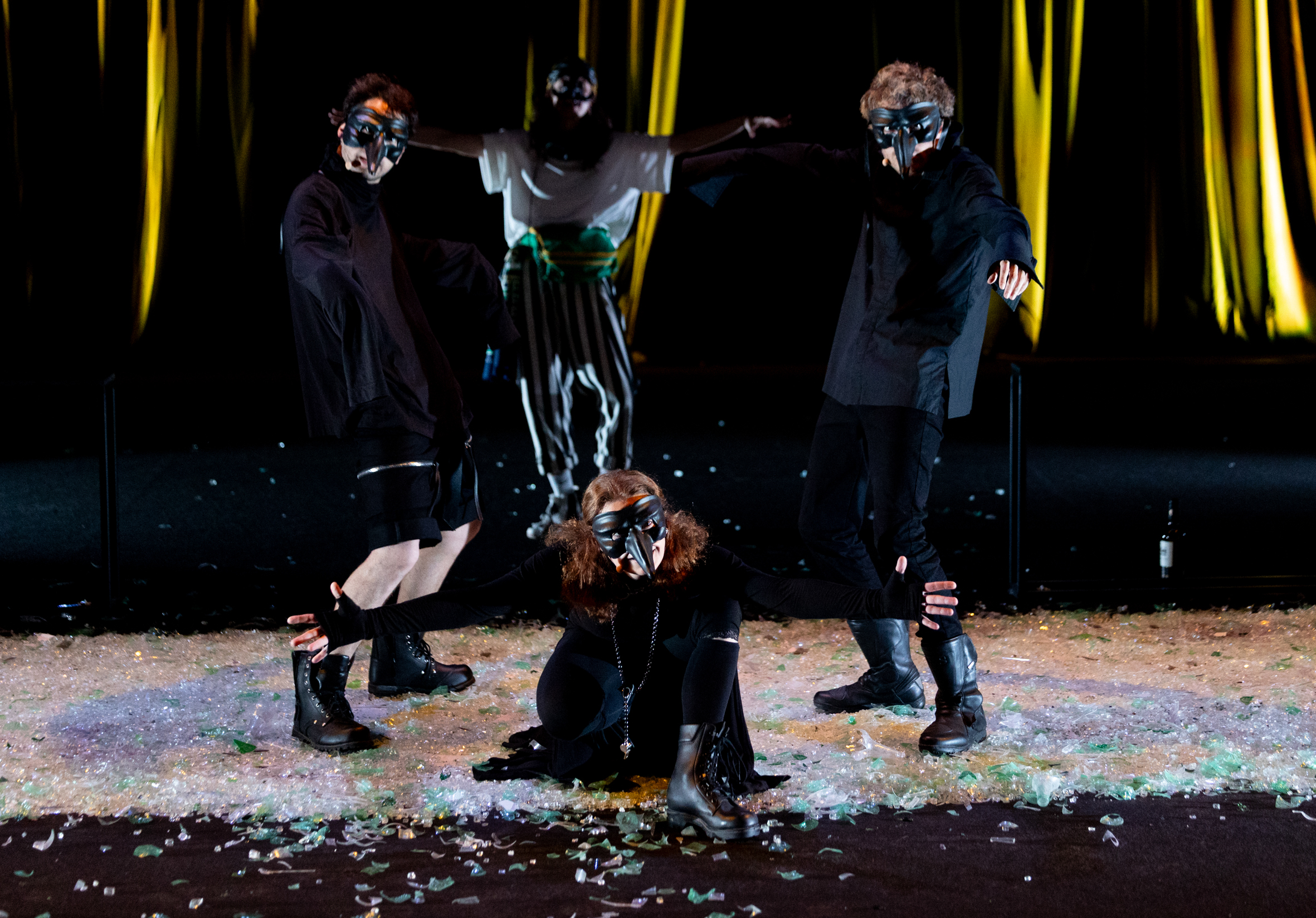
Not everyone speaks Georgian, but everyone is hoped to speak the language of truth. At the Teatro India from May 6 to 17, every evening a toast is raised gaumarjos ("victory") in the name of rights, freedom, and independence. Telling the story of a devastated theatre company, a young European traveller, Paola Giannini, discovers a Georgia with an unstable political situation. La Festa by Leonardo Manzan and Rocco Placidi stages, through the device of the Supra, a dance of toasts, a society in struggle, a destiny worth fighting for.
Three Georgian actors (Giorgi Baratashvili, Zurab Papuashvili, Anna Tsereteli) from the now-established theatre company of the New Theatre in Tbilisi are on stage. Are they really just actors on stage? Or are they performing their true anger? In Manzan's shows, it is no surprise to find oneself in a limbo between reality and fiction, but when reality is so present and lucid, it feels like being in an assembly, part of a demonstration, listening, ready to catch testimonies and not a passive gaze at fiction.
The device of the Georgian symposium, the supra, is not accidental. The now-seasoned duo of Manzan-Placidi has been weaving ties with the world of Georgian theatre for years, bringing their Cyrano must die to the New Theatre in Tbilisi. A fateful performance was that in December 2024, in the midst of the street protests for the parliamentary elections, defeated by the results, the actors hold a traditional supra.
Unexpectedly, despair united the fates of the Georgian company and the Italian artists. The supra is a device that stages anger and terror, but also joy and the desire for redemption.
Even in the turmoil, the Georgian people know how to be joyful and convivial, an approach that is not relaxed, but without crying, as are the demonstrations of the pro-European Georgian society. A peaceful revolution.
A few simple rules for the Supra: The tamada sets the pace of the banquet. In turns, a toast is raised, and everything is drunk in one gulp. One does not drink while a guest is speaking; if wine spills, a prayer is said to the good Lord. Every evening La Festa changes, every show comes to life in a unique way, with the changing audience. Once seated at the Teatro India, who knows which toast will awaken the audience's reaction.
Language and customs are the laws of belonging, but in La Festa, everyone feels part of a common language. A language that knows no barriers: Georgian, considered a difficult language to learn, becomes grammelot. Between supertitles and pseudo-words, it speaks to everyone. An unknown but collective language, brought to its extreme consequences. The music performed by Irakli Getsadze blends with the creaking of a carpet of glass, of shards of bottles and glasses, of who knows what supra. The only furrow marking a frontier between stage and audience is a glass threshold, a boundary that is broken; a boundary this time visible and physical, unlike geopolitical boundaries, which however, instead, are sharp. Imaginary lines, with real effects on people's lives, on the world.
How many toasts shattered, but stopping is forbidden! Courage or madness? A destiny to carry on one's back, that of the Georgians who bring us their testimony. The show has a strong political scope, it makes us reflect on the controversial aspects of demonstrating. There is no distance that holds if the goal is common. Fighting for a free Theatre, not only in Georgia, is a risk.
The party ends.
The actors bow, but only to the applause.
Benedetta Melone