After a second reading, Valerio Binasco finally finds what he had been waiting for in a text: a play that allows him and his actors to let themselves be carried away by the characters without thinking about the various consequences and doubts that every actor on stage constantly faces.
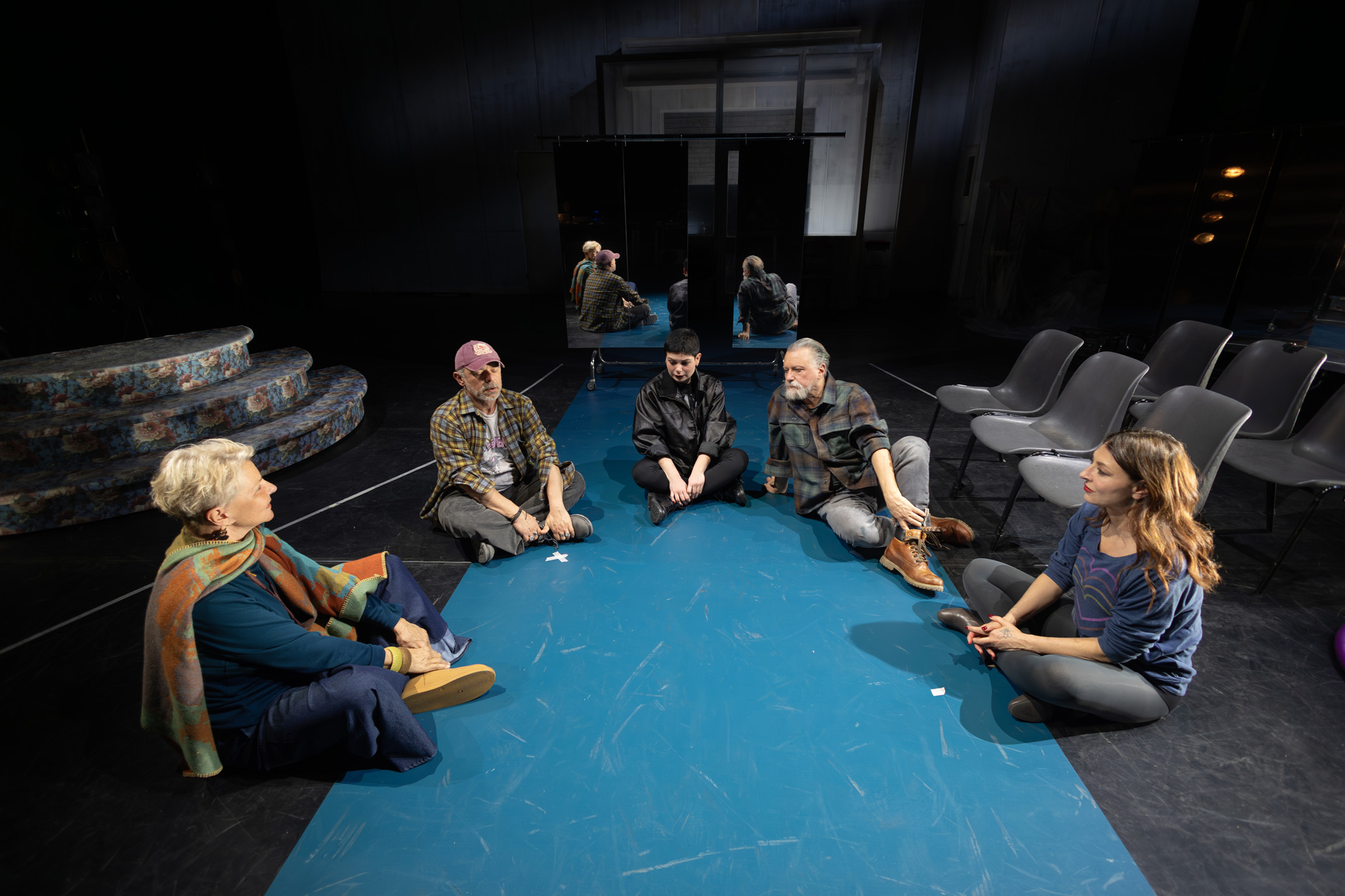
In a provincial town, four students attend classes taught by a drama teacher. On the surface, it is a play where “almost nothing happens,” but the real change takes place within the characters themselves. The setting is a grey space with few usable objects, filled mainly by the stories brought by the different characters. The play begins with James (Valerio Binasco) and Marty (Pamela Villoresi) opening the theater workshop and laying out a blue carpet that extends beyond the proscenium, a request and an invitation to the audience to join their game and let themselves be carried away by whatever may happen. Immediately after the characters enter, they begin the first exercise, which sets the rules for this workshop—and for the theater world in general: counting to ten. Taking turns, without any particular order, the characters must start counting and reach ten without overlapping. This exercise is repeated throughout the play to demonstrate the growing trust and intimacy among the characters. After the warm-up comes the first real exercise: telling each other their stories. Amidst appearances, barriers, and fears, we share little with strangers, especially when asked to remember what each person says about themselves.
And that is where it begins, with the silence that follows the explanation of the exercise and the pauses each character takes while trying to organize their thoughts and figure out what is right to share and what is better left unsaid. But what does this trust cost us, and how much? Who can say it won’t be abused or perhaps even turn against us? Despite the premises of a meta-theatrical text, the characters are not there to become actors. Rather, they have come together to find an escape and shed a burden without being judged.
In a text full of everyday words where a deeper, more intimate connection is avoided, a pause and a look are all that is needed to decipher them. An extra word exchanged during the break, or perhaps even outside the workshop, draws us into the subtle personal stories of the individual characters. The first connections and ruptures begin to emerge, where conflicts are not expressed but remain suspended, allowing relationships to wear away on their own as time passes, reminding us that there is an end to all this, even if it is not always visible or results in a major conflict.
The characters begin with a profound sense of loneliness, searching for what they lack: whether it be contact, a little empathy, or simply a distraction. This becomes apparent when, returning to what each character said about themselves at the beginning, something is omitted from their stories and only the “positive” parts are remembered, almost as if to reassure the other that they have had and can still have a positive impact, even if they do not always realize it.
Francesca Maddalena